Be yourself; Everyone else is already taken.
— Oscar Wilde.
This is the first post on my new blog. I’m just getting this new blog going, so stay tuned for more. Subscribe below to get notified when I post new updates.
Be yourself; Everyone else is already taken.
— Oscar Wilde.
This is the first post on my new blog. I’m just getting this new blog going, so stay tuned for more. Subscribe below to get notified when I post new updates.
The Stock market crash of 1987 caused a rapid and severe downturn for practically all US stock prices. This crash also impacted all the other major world stock markets. It is speculated that the roots of the crash came from a series of monetary and foreign trade agreements. These trade deals deprecated the U.S dollar in order to adjust to trading deficits and then attempted to stabilize the dollar at its new lower value. This caused increased selling pressure in the worlds stock markets. On October 19, 1987, selling pressure had reached its peak, also known as Black Friday. The significant amount of selling resulted in steep declines, and total trading volume was so large that the computerized trading systems could not process all of them. Then on October 22, 1987, also known as Black Monday, the stock market has reached its largest percentage drop in one day history. This crash brought fear of extended economic instability all around the world. Also since there was a mass of trading volume in this period, the computerized trading systems could not process some orders leaving them unfilled, and these order imbalances prevented true price discovery. The Stock Market Crash of 1987 revealed the role of financial and technological innovation in increased market volatility.

After the Cold War ended, the United States economy postwar was experiencing phenomenal economic growth. Gross national product in the United States jumped from about $200 thousand million in 1940 to $300 thousand million in 1950 to more than $500 thousand million in 1960. As time went on, more and more Americans considered themselves as part of the middle class. In this postwar period, many American also migrated mainly to the west or southwest to expand their family and in hopes of finding affordable housing for larger families spawned by the postwar baby boom. Sun belt cities like Miami, Florida, Albuquerque, New Mexico, Houston, Texas, and Tucson, and Phoenix, Arizona expanded rapidly. However, farmers on the other hand, were faced with tough times. Gains in productivity led to agricultural consolidation, as farming became a big business. Family farms, in turn, found it difficult to compete, and more and more farmers were forced to leave their land. Also, as the suburbs grew, many businesses moved into large shopping centers with a great variety of stores, that ultimately revolutionized consumer shopping trends and patterns. New highways also created better access to the suburbs and shops. Television as well had a powerful impact on social and economic patterns. In 1946 the country had fewer than 17,000 television sets. Three years later consumers were buying 250,000 sets a month, and by 1960 three-quarters of all families owned at least one set. The advertisements or commercials at this time impacted Americans of all ages because Americans were becoming increasingly exposed to sophisticated advertisements for products that were said to be necessary for the good life.
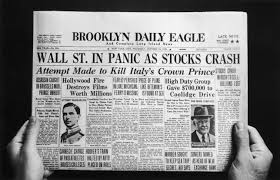
The 1929 crash was a major stock market crash that occurred on Wall Street in New York, New York in 1929. Some people believed it was the abuses from the utility holdings companies that contributed to the Wall Street crash of 1929, but most people blame the crash on commercial banks that were to eager to put deposits at risk on the stock market. The Dow Jones, which is a a collection of 30 large companies, had dropped 24.8% on the stock market in 1929. This led to one of the worst declines in U.S history, and ultimately it destroyed confidence in the Wall Street markets and led to the Great American Depression. This panic famously first occurred on October 24th, 1929, also known as “Black Thursday”. On that day a record 12.9 shares were traded as investors rushed to salvage their losses, but the Dow still closed 6 points down after many of the major banks and investment companies bought up great blocks of stock in a successful effort to stem the panic that day. Ultimately, however, their attempts failed to shore up the market. On October 28th, 1929, or “Black Monday”, the market closed 12.8 percent down, and it only continued to regress. The Dow Jones wasnt able to fully recover until about 20 years later, when their stock was finally able to surpass the 200-point level.
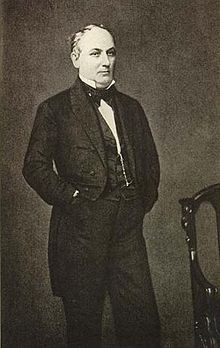
In the early 1900s entrepreneurs wanted to expand and buy other companies, which created new lending opportunities for some New York lenders such as J.P Morgan. Interstate banking and breaching, also known as unit banking, became restricted, however some states began allowing branching at the state level. The panic of 1901 began when Standard Oil purchased the Northern Pacific railroad stock and triggered a stock market panic. Thousands of small investors were wiped out. Then in 1905, it was discovered that some wealthy businessmen were using unscrupulous tactics in their business operations and on the stock market to amass huge profits. These businessmen were referred to as robber barons, and included John D Rockefeller, J.P Morgan, and Andrew Carnegie. Many of their massive businesses controlled a large majority of all activity in their respective industries, which often arrived as predatory pricing schemes that would nowadays be considered illegal

The first article titled “James Henry Hammond and the Plantation as a Business Enterprise” was mainly about how a plantation and slave owner names James Hammond became one of the wealthiest men in the entire country during the 1830’s and 40’s. In 1831 James first took over his fathers plantation inheriting slaves, the value of the land, and other plantation assets. Hammond did not wait long to introduce new innovative agricultural changes and systems. He wanted to build on his fathers by developing such “agricultural success that could distinguish the ambitious carolinian among all the other planters of the South” (p.31). Hammond experiences peaks and dips in his illustrious career as a plantation owner. His plantation served as a place for control and achievement. He was a leader in the agricultural industry and later became known as an innovative role model for early American business.
In the next article, “The Business of Slavery and the Rise of American Capitalism”, explained how the business of slavery came to be and how it shaped the economy during its existence. The slave traders were more recognized as business men or insiders, who rather than social outcasts, became some of the U.S’s most ingenious merchants. It explained how these individuals who were recognized as entrepreneurs, shaped the business of slavery and overall influenced the trajectory of American capitalism. However the book also explained how there were many backlashes or consequences of American capitalism. One of which was many of the market actors or celebrities played into the whole idea of slavery and produced changes in their acting. This resulted in many negative aspects in the development of American acting. Another was that, “the slavery business thrived on intergenerational theft, displacement, humiliation, and misery” (p.58). However they ultimately help shape the American economy in many incremental and unintentional ways.
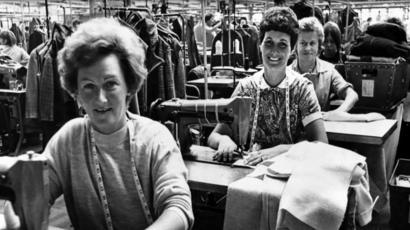
In this passage, a young factory is tasked with leading a tour through her place of business, the Lowell Mills. She talks about what she likes and dislikes about the factory life, as well as what she thinks could be improved upon or avoided in the future for potential factory workers. She first goes through all the massive factory rooms and impressive machinery that she seems to be in awe of. For example, when she walked into the first room of the factory tour, she stated “We will just look into the first room. It is used for cleaning cloth. You see the scrubbing and scouring machines are in full operation, and gigging and fulling are going on in full perfection”. She also talks about some of the other activities that she seems to very much enjoy, like using the spinning jennies and their meal time. However, as the tour progresses, she begins to talk about some of the things she strongly dislikes about the factory life. Some of which include the long hours that they work for, the low wages allowed for labor, the length of time allotted for their meals, and even the harsh and discriminatory words that she says are “not called for”. She explains that she believes it gives no one pleasure to work or be treated this way in the factory life. She strongly believes that the factory workers should be given more time off from work, better health and safety precautions, and greater pay. However, towards the conclusion of her tour she dives back into some of the positive aspects of working in the factory, such as the lectures, evening classes, and libraries that they all have access to. She concludes with saying that she strongly believes the practice of sending agents through the country to decoy girls away from their homes and with the promise of high wages, when the market is already stacked to overflowing should strongly be avoided in the future.
This is an example post, originally published as part of Blogging University. Enroll in one of our ten programs, and start your blog right.
You’re going to publish a post today. Don’t worry about how your blog looks. Don’t worry if you haven’t given it a name yet, or you’re feeling overwhelmed. Just click the “New Post” button, and tell us why you’re here.
Why do this?
The post can be short or long, a personal intro to your life or a bloggy mission statement, a manifesto for the future or a simple outline of your the types of things you hope to publish.
To help you get started, here are a few questions:
You’re not locked into any of this; one of the wonderful things about blogs is how they constantly evolve as we learn, grow, and interact with one another — but it’s good to know where and why you started, and articulating your goals may just give you a few other post ideas.
Can’t think how to get started? Just write the first thing that pops into your head. Anne Lamott, author of a book on writing we love, says that you need to give yourself permission to write a “crappy first draft”. Anne makes a great point — just start writing, and worry about editing it later.
When you’re ready to publish, give your post three to five tags that describe your blog’s focus — writing, photography, fiction, parenting, food, cars, movies, sports, whatever. These tags will help others who care about your topics find you in the Reader. Make sure one of the tags is “zerotohero,” so other new bloggers can find you, too.

 Business & Economic Development